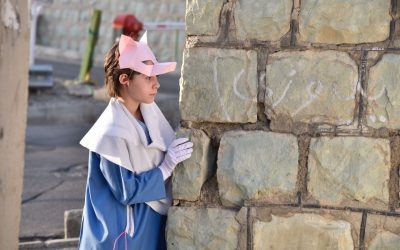
MA: Amir, I would like to begin this conversation with a question that is, in essence, ontological: for you, how did the encounter with cinema emerge in relation to the multilayered concepts of the visual language form, composition,

Mania Akbari
rhythm of movement, spatial construction, and the creation of meaning through the image? Was this entry, in your view, a passage from the static to the fluid, or from the “art object” to the “visual event”?
My own artistic journey began in the world of the visual arts first through the tangible experience of form and colour on paper, canvas, and board; by exploring composition and structure, the relationship between line and point, the dialogue between colour and form, the interaction of shape and space, and the tension between form and content, container and contained. Gradually, this visual and material practice, in dialogue with the technological shifts of our era, most notably the digital revolution, forged a connection in my gaze towards the idea of “movement within the image” and the possibility of direct, tactile control over the image in one’s own hands. From this vantage point, I am curious: for you, how did this passage from the static language of visual art to the dynamic, multi-dimensional language of cinema take shape? Was it, above all, an aesthetic necessity, or a response to the historical and technological conditions of your moment?
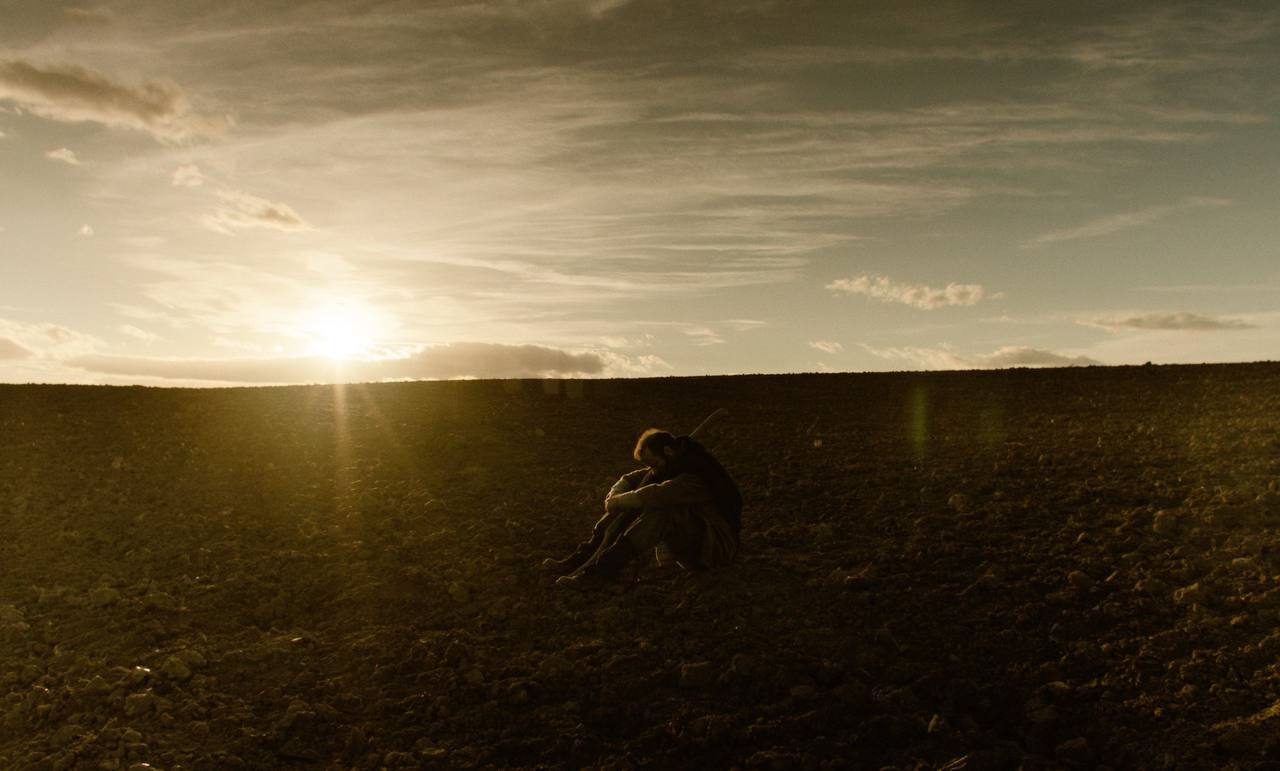
The reason behind my first question is that in your films, every moment lingers like a profound visual experience. Our encounter with form and narrative immerses us in the images and draws us into the step-by-step experience of the trauma of migration. In truth, we enter the visual gaze and the lived world of a person, seeing and sensing reality through them. This journey, in a way, invites us to witness the beauty of life and nature, which are essential parts of existence. Or perhaps it is better to say that it leads us toward a deeper understanding of nature that is often forgotten in the routines of daily life but suddenly stands before us with full force. A merciless and harsh nature that, at the same time, in its peak of beauty and delicacy, turns each fleeting moment into poetry. Your invitation and your vision come from your lived and visual experiences with form, imagery, and aesthetics; this is why each frame of your film appears like a painting. If you were to speak of painting, what would you say? Because perhaps the most important point is this: your film carries us from cinema into the realm of paintings unfolding moment by moment even in those instances when the camera lingers on the face of the old woman.
AF: Thank you Mania.
Ameer Fakher
Well, cinema for me came as a necessity and a way of holding on to fragments of memory or to places I could never return to. I grew up surrounded by silence, by landscapes that carried both beauty and absence, and I felt the need to stay with them, to give them time. In a more poetic form of expression, I would say I try to capture the slower rhythm of my dreams.
I never see an image only as something fixed or decorative. I’ve always felt an image, whether painted, photographed, or filmed, is more of a threshold through which memory and time pass. What cinema offers is a different relation to that passage, for film doesn’t just depict movement, it lets us dwell within it and uncover the temporality that already exists in stillness.
As for painting, I would say it taught me reverence, the patience to pause before a surface and to wait until form and colour reveal their hidden order to me. And in a way I find that cinema asks for the same reverence, but it unfolds under the weight of passing time. Each frame appears and disappears as we look at it. That is why every cinematic moment for me feels both merciless and tender, merciless, because it vanishes the instant it is born, tender, because in its vanishing it becomes eternal. And in those moments, cinema reminds me that what vanishes is never lost, it simply changes form in our memory.
MA: In our meeting you said: “For me, the most important filmmaker from Iran is Forough Farrokhzad.”
To me, Forough was not only a poet, she was language itself. Words did not simply belong to her; they coursed through her veins, pulsed in her hands, beat within her chest like a second heart. Rhythm and form became her way of resisting the dark monster of life. Through her poetry she gave meaning to the unseen, unveiling a hidden dimension, painting the wounded body of existence with another color, another light. And in The House Is Black, she carried that same gesture into cinema. The cruelty and violence of life she transformed into a strange, devastating tenderness. Watching her images was like entering an ocean where brutality and grace crashed against one another in endless waves. Forough made suffering and deprivation visible in such a way that, for a fleeting instant, you could dissolve into every figure on screen walk beneath their skin and from inside the frame look back, directly into your own eyes.For me, that single film was enough. Enough to turn Forough the poet into Forough the filmmaker. Enough to build an entire world, to turn being itself into a question. She proved that when cinema fuses with the raw truth of existence, it has no need for quantity. One film can be sufficient — for eternity.
And what stayed with me most was that you, too, said: “One film was enough.” Tell me, then — how did you find Forough, or perhaps, how did she find you?
AF: I first came to Forough through her poems. I was still young when I heard her name for the first time in conversations among friends, it was fragments of verses that were somehow passed around us almost like secrets. Later, I got a collection of her poetry and started reading it slowly, it was as if each line demanded silence around it. And somehow her words struck me as something more than literature, words that carried a force that seemed to come directly from life itself.
Then when I finally encountered The House Is Black, I understood that she had carried the same gesture into the cinema. The images were brutal, tender and devastating, that’s right, but above that, what struck me most was the poetry she wrote specifically for the film, it gave the film another dimension, something like a rhythm that transformed the suffering into revelation. That experience marked me deeply and has remained with me ever since.
And in a way, this encounter carried over into my own films.. In the first two parts of my trilogy – Al Garib (2021) and Yunan (2025) – I ended both films with spoken poetry. It was my way of acknowledging her, but also of expressing my belief that poetry in cinema is not there to explain or decorate. It opens a passage, and allows words and images to resonate with one another in a way neither could achieve alone.
I believe the use of spoken poetry in cinema is about opening another dimension. When poetry is spoken over images, it creates that passage where words and images echo against each other to reveal something neither could reach on their own. For me, this gesture is closer to an interior silence. Because I believe it can transform the silence of the screen into an interior silence where the spectator hears their own memory and longing resonating with it.
This is what I learned from Forough. In The House Is Black, her poetry gave a tenderness to cruelty and rhythm to silence. In my own films, I tried to honor that presence by ending Al Garib and Yunan in the same spirit as a way of carrying the image into another register where it lingers… fragile perhaps, but enduring.
MA: It is now around three-thirty in the morning as I write these lines. The moon has bent its light into my room, and sixteen small twenty-by-twenty canvases, placed beside my bed, shimmer beneath its bluish half-light. The vivid greens, blues, reds, and purples awaken in this glow, as though tiny figures painted upon the canvases had risen, gathering to hold a silent celebration one steeped in meaning. I have named this series “Mother and Child.” Do you know why I began with this image? Because this conversation has become, for me, a hidden treasure as though we are about to unveil the veiled, to reveal what existence has long kept secret. A dialogue that summons us back to meaning, to the states of being we so easily lose in the weight of suffering and the haze of the everyday.
My bond with your film, in truth, was born in painting. I was fourteen then a child marked by war and repression — struggling with loneliness both at home and in society. Under the weight of patriarchy and deprivation, my only refuge was a handful of colors upon a palette, and a blank canvas that swallowed my unrest. Behind every form and shade lay a secret, a voice yearning to be heard at the farthest edge of silence. It is no wonder that I encountered your film in the company of these very canvases, scarcely a meter away from them. It felt as if, after twenty years, a bridge had been rebuilt between me and the canvas. Long ago, I had bid farewell to painting and sought shelter in the screen of cinema. And now, for the past two weeks, amidst a deep anguish one that can only be witnessed, never truly shaped, I have returned once again to paint. For sometimes pain is too heavy to build or to render; it can only be concealed within forms and colors, kept as a secret. Cinema cannot endure the shattering of such moments, for no soul could ever bear that weight. At times, reality is so immense, so overwhelming, that all one can do is receive it with a quiet, steadfast smile.
I find it wondrous that you arrived at cinema through Forough and poetry, while I came through Forough, poetry, and painting. This harmony carries a rhythm all its own especially since I encountered your film at the very moment when, after twenty years, I had once more taken up painting. My hands felt as though they were reconciling after a long estrangement, as if at last they had returned home. Painting, to me, is innocent: a solitude without vanity, a sanctuary where one may stand before every shape and form of one’s being. Your film revealed itself to me as a fusion of poetry and painting. Its people and narrative felt almost secondary mere vessels leading me toward the profound voice of life itself, and the solitude of being human, toward a pain that can never be spoken. How beautiful it was that in your film, words were sparse, and silence accompanied by the fluid motion of the camera and the mute expressions of its characters became the subtitles of life’s deepest sentences. It was a poem, recited in the language of silence. And so I wonder: what first led you to cinema? What moment compelled you to choose filmmaking? For me, the path unfolded like a river in flow: it began with the canvas, yet the absolute solitude before its vast whiteness, and the suffering it carried, pushed me to seek a broader ground for storytelling, for connection. And in that search, the digital camera became the savior of my pain.
MA: In the film, how can Yuman, with a trauma-affected body shaped by geographic determinism and genealogy, completely detached from a new place and environment, simultaneously carry death and historical memory, while life continues? This question becomes particularly compelling when the body is not seen as an active subject, but as a foreign observer and witness; a presence constantly oscillating between nature and inner suffering, yet without direct access to reconstructing place and time.
From Walter Benjamin’s perspective, this situation can be understood through his concept of “history as a constellation of memory-images”; meaning that the trauma-affected body carries the collective and historical memory of places and times, while its experience of life in a new space reveals a “liminal state” between past and present, which cannot be reconstructed through a linear narrative of history. In this context, the body acts as a means to observe history and personal tragedy, and the film can depict this simultaneity between physical presence and historical memory. How did this idea take shape in your mind?
AF: Dear Mania, thank you for sharing such tender thoughts. As for me, I often say cinema chose me first. The truth is it wasn’t a choice at all, it was more like gravity. I grew up in Majdal Shams, a small village in Hermon mountain where we did not have any cinema theaters around. My father, a man of discipline, had other plans for me: medicine, perhaps accounting. At twenty, he sent me to the city to study numbers.
Three weeks later, I escaped. Restless one evening, I wandered into a Cinematheque. In a small theater, among five elderly patrons, I watched Antonioni’s L’Avventura. The film was in Italian, the subtitles in Hebrew, a language that was still foreign to me at the time. I couldn’t follow the dialogue, so I relied on what I saw, inventing the story as I went along. What startled me was the feeling that this was not my first time in a cinema. A few days later, I remembered: as a boy of eight, I used to sneak out of bed at midnight, turn on the TV, and tune into the only film channel our satellite could catch (likely from Syria or Lebanon). I’d mute the sound so as not to wake my parents, and for hours I would watch films in silence, stitching together the meaning myself. I kept this secret game until I was fourteen. That night with Antonioni, I realized why the darkness of the theater felt familiar: it was the continuation of that muscle I had trained as a child, to reconstruct the unseen and to invent out of incomprehension.
After L’Avventura, everything changed. I sensed that cinema carried more than stories and that it held fragments, silences, gestures that could not be explained but only felt. That was when I knew I wanted to make films. I did not survive one semester at film school either. Instead, I worked at a camera and lighting rental house, where I learned the mechanics by hand. At the same time, I buried myself in books and devoured films with obsessive discipline, two or three a day, twenty or forty from each country, alongside every article I could find online. Cinema became my education, my form of exile and return. What painting gave you in solitude, film offered me movement, somehow a place where absence and presence could live together without resolution.
As for Yunan: the body in exile is never only an individual body. It becomes a witness that carries collective memory while estranged from the present. That is how I imagined Munir, not as a man to be resolved but more as a constellation of fragments, always incomplete. However, I’ve always been drawn to Benjamin’s way of thinking, his idea of history as constellations, sudden flashes rather than a line. But my task in this film was simpler: to hold Munir in that space, and to let silence and landscape speak for him. For me, cinema at its best doesn’t explain. It protects the mystery.
MA: Considering what you’ve said, your relationship with cinema seems to have been shaped as an inner, lived experience, and your filmmaking also grows out of this perspective. When you decided to make your first feature film in 2021, where did the initial idea come from? How long did the process of writing the screenplay take? Did images first emerge vividly in your mind, leading you to build a story and structure around them? Or was it the narrative that drove the process, with images unfolding as an extension of the text? Or perhaps both happened simultaneously?
Tell us a little about how the idea was formed and the path you followed until arriving at Al gharib.
AF: The idea for Al Garib (The Stranger) was not born as a story in the conventional sense. It began with a feeling, a suffocating sense of stagnation that I witnessed in my village in the Golan Heights. I remember watching men who had once carried convictions and dreams sitting day after day in silence, as though time itself had abandoned them. There was a heaviness in the air, a paralysis. That was the seed.
I didn’t sit down and say, “Now I will write a screenplay.” What came first were images, fragments: a man in his forties lying on his bed in the middle of the day, staring at the ceiling; the fog rolling over the orchards; a stranger arriving from nowhere. These images haunted me long before I knew what they meant. Slowly, I began to write around them, to search for the man behind that stillness.
The process of writing took nearly three years. I wrote and rewrote, not to perfect a plot, but to discover the pulse beneath it. For me, writing is never a linear act; it’s closer to excavation. You remove layers until the essence reveals itself. The film grew out of that excavation. The character of Adnan was not constructed, he was uncovered. He is the reflection of a generation that carries disappointment in its bones, that survived wars but could not escape the quiet violence of futility.
So the answer to your question is both: images and narrative arrived together, like two mirrors facing each other. Sometimes an image demanded a story, and sometimes a sentence gave birth to an image. What kept me going was not the logic of narrative but the urgency of atmosphere, to capture the fog, the silence, the sense of estrangement that defined the place I came from. Al Garib was, in many ways, a confession, told in landscapes, gestures, and silences. It was less about inventing a story than about holding a mirror to a reality I could no longer ignore.
MA: The beginning of Al Garib rises not from a narrative, but from a feeling; and this, in itself, leads us back to the very source of art. In the history of artistic creation, it has always been “feeling” and “image” that stand before language, before story, before structure. Just as in the ancient caves, the first human artists did not inscribe a continuous tale, but rather the tremor of hands and the eruption of inner images upon the walls. What the filmmaker recounts is the repetition of that primordial moment: the moment when art emerges as an existential necessity, not as a rational choice.
This encounter with stillness, with fog, with the stranger, recalls the very essence of poetic art—art that, in Heidegger’s words, reveals truth in its nakedness. Art does not construct or add, but rather unveils what has long been hidden within the world. Here, Adnan is not “created,” but drawn forth, like a sculpture released from the stone; just as Michelangelo once said: “I saw the angel in the marble and carved until I set him free.” Al Garib is not in pursuit of storytelling, but of giving language to atmosphere: to fog, to silence, to estrangement. This is the very realm to which poetic cinema has always belonged from Tarkovsky to Parajanov where narrative recedes in the face of presence and time. Here the image is no longer a tool but the very essence itself: a lived truth, a visual confession. What makes this film distinct, however, is not only the poetical quality of its language, but the fact that it rises from the wounds of contemporary history and collective experience. Here, art and the philosophy of history intersect: a generation that has endured war and survived, yet carries despair deep within its bones. This “silent violence of futility” is precisely what modernity has imposed upon so many lives in its silence; and cinema, as a poetic mirror, draws it forth from the shadows. Thus, Al Garib is more than a film: it is a moment of history confessing itself in the language of images; a confession of life within silences, within halted time, within the absence of hope. It is not merely the story of one man, but the echo of an entire era. In the process of shaping Al Garib, what role did the choice of locations and spaces play? Did the ideas and images first emerge in your mind and then lead you to search for places that matched them, or did the locations themselves inspire the images? The atmosphere of the film has a very distinct character. Could you talk about how you selected the locations and the role they played in creating the film’s poetic atmosphere? And those particular spaces and silences—where did they come from? Were you mainly seeking out places that would amplify the inner feeling of the film, or did the locations themselves pull the narrative toward them?
AF: The spaces in Al Garib weren’t chosen as scenery. They were part of the film’s inner reality from the beginning. I didn’t write a story and then go looking for places that could fit it, it was almost the opposite. The images I carried in my head came from the landscape I grew up in, even before I started writing. The Golan Heights has a silence that is very particular, not peaceful, but heavy, charged. The fog, the stone, the horizon that ends abruptly at a border fence, all of that carries history and loss. I wanted the film to grow from that tension, not to decorate it. When I came back to shoot, I realized that what I had imagined on the page already existed there, almost waiting. Sometimes the place dictated what would happen; I would change dialogue, or remove it completely, because the space said it better. So it wasn’t about finding locations that looked cinematic. It was about finding spaces that felt true, places where you can sense the weight of time, where silence becomes part of the story. For me, the Golan is not only the background; it’s the subconscious of the film. Everything, the pace, the framing, even the pauses between lines, came from how that land breathes.
MA: It is midnight, and thinking about your film releases me from thousands of personal and collective pains; it is an invitation to a deep, almost sacred pleasure, as I envision every single moment of your work. It feels as though your film never truly ends within me, as if it has no final frame, and this sensation is both strange and profoundly stirring. In your reflections on the spaces and the breath that the land of the Golan lent to the film, you mentioned that the locations were part of the film’s inner reality from the very beginning, that even the images in your mind had taken shape before you began writing. I am curious about the choice of the main character: how did you discover him in such a way that he resonated so completely with the texture, rhythm, and silence of that land? How did his presence and movements not merely inhabit the space, but become inseparable from the very existence your film conjured? From the perspective of acting theory and film studies, casting extends far beyond finding a “suitable appearance.” An actor must not only embody the role but achieve a profound consonance with the environment and the thematic core of the film, a phenomenon often described in academic texts as the “embodiment of space.” His presence must align with the film’s time, silence, and visual rhythm, so that acting becomes inseparable from the cinematic discourse and the emotional heartbeat of the work. I wonder how this harmony was realized in practice, and what process led you to choose an actor whose presence naturally and deeply merges with the “subconscious” of the film itself.
AF: Dear Mania, thank you for these words. It warms up my heart to hear that the film stayed with you, films that end when the screen goes dark don’t interest me either.
About the main character: I didn’t “create” Adnan and then go look for someone to play him. I had been carrying this man inside me for years before I knew he would become a film. I knew his silence before I knew his name. I knew the heaviness in his chest, the feeling of being trapped in a place that is both home and prison. I knew his exhaustion.
So I was not looking for an actor, I was looking for a presence. Someone whose face could carry time. Someone who doesn’t perform emotions but holds them. Someone who understands that silence is not emptiness.
I found that in Ashraf Barhoum. The first time we spoke, I didn’t tell him the story. I just talked to him about waiting, the weight of it. I watched how he listened. He didn’t rush to answer. He has that rare ability to exist fully in stillness without disappearing inside it. That was essential. In a landscape like the Golan, open, brutal, honest, someone who tries to “act” gets swallowed. But someone who simply is becomes part of it.
We didn’t rehearse scenes in the traditional sense. We built a rhythm. I asked him to move slower than he normally would, to breathe with the landscape, not above it. I told him: “Your body is carrying things you will never say, let the camera find them.” And he understood immediately.
You mentioned “embodiment of space.” For me, it’s simpler than theory: either a person belongs to the frame or they reject it. Ashraf belonged to it. He didn’t decorate the image, he completed it. He didn’t stand in front of the landscape, he allowed it to pass through him. That’s why, after a point, the line between the actor and the land disappeared. He wasn’t just in the film, he carried its pulse. Casting him felt it was recognition rather than just a decision to be honest.
MA: Your words touched me deeply, and reading them felt like stepping into the same still, luminous space that your film creates. What you described the way you carried Adnan within yourself, understood his silence, his heaviness, and exhaustion resonates profoundly with me. It reminded me that true presence, both in life and art, is not about performance but about being. Presence carries time, carries depth, and allows a dialogue with the world that is unspoken yet unmistakably felt. Your film, for me, is about freedom — not the freedom to escape, but the freedom to be. It is about light, purity, and a silence that is not emptiness but a profound state of being. Watching it, I felt that everything the stones, the air, the landscape was alive, and that the characters were not separate from it, but a part of its pulse. In this way, your cinema reminds us that humans are inseparable from nature, and when we dissolve the borders between self and world, between body and landscape, we begin to truly see. Your work is healing: watching it, one connects with light, hope, and the quiet intimacy of being.
Yesterday, I had a similar experience with painting when I went to see Kerry James Marshall at the Royal Academy in London. His work was astonishing. In listening to his conversation, he said that when he paints Black people, we see “black,” but he uses hundreds of different blacks. The surface is one color to the eye, yet beneath it exists immense layering, nuance, and life. For me, this revealed something universal about art and perhaps about life: there is always more beneath the surface, and depth is created from layers of experience, struggle, and love. Marshall spoke in his interviews about how art is a platform for ideas, a tool for healing, and a way to restore presence to those historically absent from narratives. He paints layered stories, confronts uncomfortable histories, and challenges us to see beyond what is obvious. In his work, I saw a connection with your film: many hidden layers, not immediately recognisable, come together to shape a character, a presence, a reality intertwined with nature, carrying light, love, and intimacy out of trauma. Both your film and his paintings create spaces where healing, reflection, and understanding can emerge.
Seeing your film through this lens, I realised how it mirrors that layering. Every moment, every gesture, every pause in your characters’ presence carries weight and depth, revealing the unspeakable and the invisible. Your careful attention to rhythm, breath, and the landscape, and your understanding that silence is not emptiness, is exactly what makes the film luminous. Ashraf Barhoum embodies this perfectly: his presence is not performance, it is being, and through him the landscape, the air, and the film itself breath and pulse. Your film is a gift a space of light, of quiet transformation, and of deep connection to nature and to the human spirit. It reminded me that in art, as in life, pain can transform into light if we are already part of it, and that presence, honesty, and attention are the pathways to seeing and feeling the truth of being.
Some cinematic works immerse us in the shadows of existence in despair, suffering, or the weight of human experience in such a way that after the film ends, the viewer remains trapped in that shadowy space, sometimes even experiencing a physical and psychological disturbance. A notable example of this can be seen in the works of Lars von Trier. In contrast, other films have the capacity to establish a luminous and hopeful connection with life, guiding the viewer toward light, liberation, and a renewed understanding of existence. From a philosophical and film-theoretical perspective, what factors determine whether a cinematic work produces a “dark and heavy” experience or a “light and liberating” one for the viewer? Are these factors solely related to narrative structure and story content, or do the viewer’s consciousness and capacity for reflection, the rhythm and silence of the film, the visual language, and even the deeper resonance between the film’s pulse and the human psyche play a decisive role?
Furthermore, how can we analyse and conceptualise the relationship between the viewer’s psychological-emotional experience and the director’s cinematic strategies including imagery, lighting, music, and temporal-narrative structure to understand why some works ensnare us in darkness while others connect us with light and hope?
AF: I’m grateful and impressed for how attentively you watch and listen. What you describe actually touches something essential for me too. I don’t think films are dark or luminous because of their subjects alone. Suffering, loss, violence, despair… These are part of life, and avoiding them would be dishonest. What matters to me is not what a film looks at, but how it looks, and from which inner position it does so. I think a film becomes heavy when it closes itself. When it insists on a single emotional direction, when it traps the viewer inside despair without air, without rhythm, without space to breathe or reflect. In those cases, the film overwhelms instead of accompanying and the viewer is pushed rather than invited. What I look for is something else: a state where the film trusts the viewer.
Rhythm plays a decisive role here. If time is allowed to unfold naturally, if images are not forced to explain themselves, the viewer can enter the film with their own breath, their own memories. Light then doesn’t come from optimism, but from honesty and openness. Visual language, sound, and music are not tools to manipulate emotion, but to create a shared space. In that space, the viewer is not reduced to a passive receiver. They become present. Their own consciousness completes the film. That’s why two people can watch the same work and come out with entirely different experiences. For me, cinema becomes healing when it does not try to rescue the viewer, nor to drown them. It simply stands with them. It allows pain to exist without turning it into spectacle, and allows stillness without fear of emptiness. When a film respects time, bodies, and silence, it gives the viewer permission to stay with what is difficult and that, in itself, can open a path toward light. So the difference you describe is not a matter of darkness versus hope only, but of intention and care. As you surely know, some films press their weight onto the viewer and others leave room for life to pass through. As for me, I’m only interested in the second kind.
MA: My relationship with your work is such that, in anticipating your next film, a woven sense of concern and curiosity arises within me. This concern stems not merely from the expectation of a new piece, but from a desire to understand the trajectory of your creative journey: What will your next film be? To what extent will it surprise us, as an audience? Will the success of this film, along with critics’ reviews and audience responses, guide you toward a form of caution, or will you continue your path with resilience and boldness? Audiences often expect that each new film from an influential filmmaker surpasses the previous one, yet this external pressure is not within the filmmaker’s control. Within this context, I wish to know: Are you currently on the path of creating your next film, or do you need a period of silence and distance to reflect after this film’s journey before shaping the next work? I would be grateful if you could share a bit about your mental process, concerns, and reflections as you approach the next film, so I might understand how past experiences and present reactions guide you in your creative movement.
AF: I think of the time after a film as a landscape after rain. The ground is still wet, the air is heavy and sounds travel somehow differently. Nothing should be built there too quickly. One has to walk through it, slowly, without intention, and listen to what remains. When a film ends its journey, it does not leave me empty but it leaves me sensitive. Images continue to surface often without form. They are not yet cinema. They are closer to memory, to dreams that return without explanation. I do not try to organise them. I let them exist, the way one allows a thought to pass without holding it. And well, expectation exists around a film but it belongs outside the work. Cinema, for me, cannot respond to anticipation or measurement. It responds only to inner necessity. And when that necessity is absent… any movement would feel false. So I wait attentively… I do not think about the next film as something that should surpass the previous one. Each film has its own time, its own moral weight and its own silence. The question is not whether it will surprise others but whether it will demand something honest from me, that’s always the first question. If it does not demand a change in my way of seeing, then it is not yet ready to exist. At the moment, I am living inside this interval. I walk, I observe, I remember. Certain images repeat themselves quietly. Certain questions return without urgency. I trust repetition more than excitement. What remains after time has passed is usually what matters. When the next film usually begins, it doesn’t come as a decision but it arrives more as a recognition, because the moment when “remaining silent” would no longer be faithful to what insists on being seen. That is how I move forward. Through attention… Through patience… Through listening to time, the external and the internal…